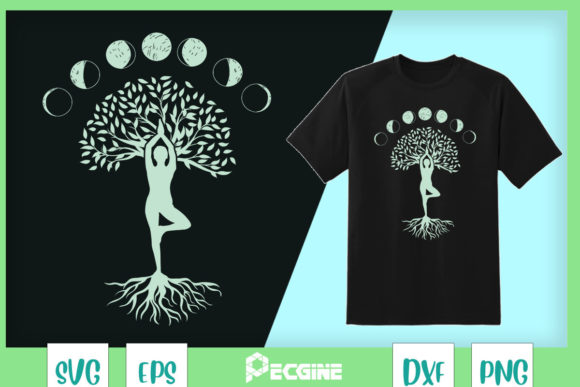
Tree of Life Phases of the Moon
A Designer’s First Look: Calm, Symbolic, and Ready for Stitching
When I opened the Tree of Life Phases of the Moon design, my first thought wasn’t “pretty”—it was “purposeful.” The composition balances organic flow with celestial precision: roots curl like gentle waves, branches arc upward in soft symmetry, and the eight moon phases nestle along the limbs like quiet milestones. It doesn’t shout—it breathes. That makes it ideal for projects where meaning matters more than flash: baby onesies, nursery wall hangings, meditation pillows, or boutique sweatshirts meant to be worn—not just seen. As a designer who’s stitched hundreds of motifs for small shops and Etsy sellers, I appreciate how this graphic avoids visual clutter while still holding attention through thoughtful rhythm and symbolic weight.
How It Lives on Real Fabric—Not Just Screens
I tested Tree of Life Phases of the Moon on a medium-weight cotton tote bag first—my go-to for evaluating embroidery file versatility. The clean linework translated beautifully into satin stitch trunks and delicate running-stitch branches. No jagged edges, no collapsed details. The moon phases stayed distinct even at 3.5 inches wide—critical when you’re stitching for baby embroidery or personalized gifts where subtlety reads as care, not compromise. On a charcoal crewneck sweatshirt? It held up with rich contrast using matte black thread against heather grey fabric. On a cream linen tea towel? A single-tone fill stitch kept it elegant without bleeding into the weave.
This isn’t a design that fights fabric—it collaborates with it. That said, it does ask for intention. On thin jersey t-shirts, I’d add lightweight tear-away stabilizer *under* and cutaway *behind* to prevent puckering around the central trunk. On curved surfaces like caps, I’d avoid placing the full motif across the front panel; instead, I’d isolate one moon phase + a single branch tip for side-embroidered caps—a smart adaptation for craft business owners building cohesive collections.
Where It Shines—and Where to Pause
- Perfect for: Embroidered patches (great stitch definition for iron-on backing), nursery decor (soft symbolism aligns with baby embroidery trends), holiday embroidery (think solstice-themed gift sets), and custom apparel for wellness brands or yoga studios.
- Use carefully on: Stretchy knits without proper stabilization, dark fabrics where fine moon details could blur without high-contrast thread, or textured fabrics like bouclé where dense fill stitches may flatten the surface too much.
- Avoid on: Tiny hoops under 4x4 inches—some branch tips and moon outlines need breathing room—or layered garments like reversible jackets where stitch density might cause bulk.
What It Adds to Your Finished Product—Beyond Aesthetics
Embroidery isn’t just decoration—it’s trust. When a customer sees Tree of Life Phases of the Moon stitched cleanly onto a handmade pillow cover, they don’t just register a pattern—they register intention, craftsmanship, and narrative. That lifts perceived value. For Etsy sellers, that means better photo storytelling in listings. For small shop owners, it means repeat buyers who return for “that calming tree design.” And for commercial embroidery shops, it means fewer reworks—because the vector-based clarity of the included SVG, EPS, and DXF files scales cleanly from 2-inch patches to 8-inch wall art without pixelation or distortion.
I’ve seen similar themes fall flat when line weights are inconsistent or moon phases lack differentiation. Not here. Each crescent and full circle has intentional spacing and contour—no guesswork needed for stitch programming. That saves time during digitizing prep, especially if you’re adapting it for applique design or multi-color satin stitch runs.
Practical Notes Every Embroiderer Should Check Before Stitching
- Test the design on scrap fabric matching your final product’s weight and stretch—especially for baby embroidery or sweatshirt embroidery where comfort is non-negotiable.
- Review stitch density in your embroidery software. If it feels heavy in the trunk area, reduce fill stitch percentage slightly—this maintains texture without risking fabric distortion.
- Confirm hoop size compatibility. While the design fits standard 5x7 hoops comfortably, double-check before loading into your machine—especially if you’re using older embroidery machines with tighter memory limits.
- Inspect small details in black-and-white mockups. Does the new moon phase still read clearly? Does the root system hold its shape against dark fabric backgrounds?
- Verify licensing terms before selling finished products or digital embroidery file bundles. This design comes as a T-Shirt Design and Graphics asset—but commercial use rights aren’t implied unless explicitly stated by the creator.
Final Thought: A Quiet Anchor in a Busy Market
In a sea of loud, trend-chasing graphics, Tree of Life Phases of the Moon stands out by leaning into stillness. It’s not built for virality—it’s built for resonance. That makes it unusually versatile: equally at home on a minimalist apron for a ceramicist’s studio, a gender-neutral baby blanket, or a limited-run embroidered patch for a bookstore’s astrology night. As a designer who evaluates hundreds of embroidery files yearly, I can say this—one glance tells you it was made with respect for both symbol and stitch. It won’t overwhelm a garment. It won’t confuse a customer. And it won’t let down a craft business betting on authenticity over algorithm.
If you’re choosing between dozens of moon-themed designs for your next batch of custom apparel or printable mockups, let this one earn its place—not because it’s trendy, but because it stitches true.